



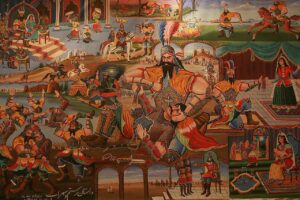
Shahnameh, Akharesh Khosh Ast — The Shahnameh is said to end well
My name is Sohrab Gebraeil.
 Gebraeil is the Persian way of saying Gabriel — גבריאל, the name of the angel.
I’ve always been interested in what words mean, especially my own name. But I don’t think there is any need to translate Gabriel for ITA members — I assume you already know it.
Sohrab, on the surface, means something like “red cheeks.” Not the most serious name for a man, maybe. But in Iranian culture, a child with red cheeks was seen as a healthy one, a strong one. So underneath that simple meaning, the name carries something deeper — strength, vitality, life.
And Sohrab is not just a word. It’s a name that comes from the Shahnameh, written by Abul-Qasem Ferdowsi around a thousand years ago. Ferdowsi wrote it at a time when Arabic influence on Persian was very heavy, and he was so dedicated to largely using Farsi-rooted words when writing the Shahnameh, which has become one of the strongest reference points for preserving the Farsi language.
The Shahnameh is, in many ways, the story of Iran — told through myth, history, kings, and heroes.
Sohrab is one of those characters.
He is the son of Rostam.
And Rostam is not just any character. He is the hero. The undefeated one. But more than that, he represents something larger — not a king, not power, but Iran itself. Its strength, its identity, its continuity.
When I was a child, my father used to tell me stories from the Shahnameh. Of course, one of my favourites was always the story of Rostam and Sohrab. But when I was very young, he didn’t tell me the story as it really is. He would change the ending.
Every time he told the story of Rostam and Sohrab, he would bring it to the moment where Rostam is about to strike — and then stop. And instead, he would say that Rostam realizes just in time that Sohrab is his son. That they recognize each other, embrace, and live happily ever after.
Until one day — I remember it very clearly — he told me the real story.
He said, “You’re old enough now to hear it as it is.”
And that day, the story ended differently. Rostam did not stop. He killed Sohrab. And only afterward did he understand who he was. But it was already too late.
That tragedy has always stayed with me.
Because Rostam is supposed to be the just one. The honest one. The strong one. The one who stands for what is right. And still, even he becomes part of a story that ends in pain.
And that is not unusual in the Shahnameh.
Again and again, the good people die. Justice does not always come. Loyalty is not always rewarded. Betrayal is everywhere. Even Rostam himself does not get a glorious ending. He dies through betrayal, at the hands of his own brother Shoghad.
And the Shahnameh itself does not end in some simple victorious way either. It moves toward the fall of Iran and the arrival of a new era after the Arab conquest.
So when I chose the title of this piece, I had to smile a little.
Because in Persian we have a very common saying:
Shahnameh, ākharesh khosh ast.
“The Shahnameh, in the end, ends well.”
But it doesn’t.
Not really.
Sohrab’s story does not end well.
Rostam’s story does not end well.
And the Shahnameh itself does not end well.
There are more tragic endings in the Shahnameh than there are good ones.
So why do we say it?
I don’t know the exact origin of the proverb, and maybe that is not even the important part. What matters more to me is what it says about us.
Maybe, when Iranians say this, we do not really mean that the book itself has a happy ending. Maybe we mean that the Shahnameh does not end where the last page ends.
Maybe we mean that it continues through us.
Maybe the living Shahnameh is the Iranian people themselves. We continue the story. We write the next chapter. We go through uprisings and quiet times, good choices and bad choices, dignity and humiliation, hope and disappointment. We fall, we recover, we lose, we build again.
And still, somehow, we say: it will end well.
There is something very Iranian in that. A kind of resilience. Maybe even a kind of beautiful stubbornness. Maybe even a little naivety. But also a deep belief that history is not finished just because one chapter ends badly.
And this is one of the reasons I have always felt there is something familiar between Iranians and Israelis.
Of course, the histories are different. The languages are different. The stories are different. But the emotional vocabulary is not always so different.
In Hebrew, there is the word Tikva — hope. It is such a simple word, but it carries so much. Not naive optimism, not pretending that things are easy, but the decision to keep a place open for a better future.
I think that is something our peoples understand about each other.
It goes beyond one word, of course. It is in the way both societies carry history. It is in memory, survival, continuity, and the refusal to let tragedy have the final word. There has also been sympathy between the two peoples in different moments of history, and that too is part of the story.
And when I think about that shared thread, I also think of Cyrus the Great, whose name lives warmly in Jewish history because of the return and rebuilding he supported.
Now, if we come to today, these are not easy or comfortable days. There is war, uncertainty, fear, and a lot of pain in the region.
But from my own personal experience — from my family members in Iran and from many friends and connections there — what reaches me whenever communication is possible is not only exhaustion or frustration. It is also hope.
That is what strikes me every time.
Even under pressure, even when communication is actively blocked, even when daily life is narrowed and made heavy, there is still this feeling, from so many ordinary people, that maybe something better can come after this. Maybe there can be more freedom. Maybe there can be more justice. Maybe the future does not have to look like the past decades.
I hear surprisingly little romance about suffering itself. What I hear more often is something else: a very practical, very human hope that one day life in Iran can be more open, more normal, more decent, more free.
And that brings me back to the Shahnameh.
Maybe that is what we have meant all along when we say:
Shahnameh, ākharesh khosh ast.
Not that the ending is already good.
Not that the tragedies are not real.
Not that the losses do not count.
But that the story is still being written.
And that, against all odds, we leave room for the hope that in the end, it can still turn out well.